## Application layer
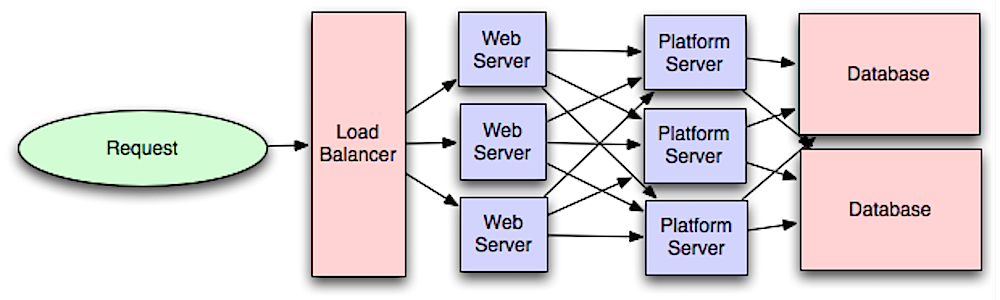
Source: Intro to architecting systems for scale
Separating out the web layer from the application layer (also known as platform layer) allows you to scale and configure both layers independently. Adding a new API results in adding application servers without necessarily adding additional web servers. The **single responsibility principle** advocates for small and autonomous services that work together. Small teams with small services can plan more aggressively for rapid growth.
Workers in the application layer also help enable [asynchronism](#asynchronism).
### Microservices
Related to this discussion are [microservices](https://en.wikipedia.org/wiki/Microservices), which can be described as a suite of independently deployable, small, modular services. Each service runs a unique process and communicates through a well-defined, lightweight mechanism to serve a business goal. 1
Pinterest, for example, could have the following microservices: user profile, follower, feed, search, photo upload, etc.
### Service Discovery
Systems such as [Consul](https://www.consul.io/docs/index.html), [Etcd](https://coreos.com/etcd/docs/latest), and [Zookeeper](http://www.slideshare.net/sauravhaloi/introduction-to-apache-zookeeper) can help services find each other by keeping track of registered names, addresses, and ports. [Health checks](https://www.consul.io/intro/getting-started/checks.html) help verify service integrity and are often done using an [HTTP](#hypertext-transfer-protocol-http) endpoint. Both Consul and Etcd have a built in [key-value store](#key-value-store) that can be useful for storing config values and other shared data.
### Disadvantage(s): application layer
* Adding an application layer with loosely coupled services requires a different approach from an architectural, operations, and process viewpoint (vs a monolithic system).
* Microservices can add complexity in terms of deployments and operations.
### Source(s) and further reading
* [Intro to architecting systems for scale](http://lethain.com/introduction-to-architecting-systems-for-scale)
* [Crack the system design interview](http://www.puncsky.com/blog/2016-02-13-crack-the-system-design-interview)
* [Service oriented architecture](https://en.wikipedia.org/wiki/Service-oriented_architecture)
* [Introduction to Zookeeper](http://www.slideshare.net/sauravhaloi/introduction-to-apache-zookeeper)
* [Here's what you need to know about building microservices](https://cloudncode.wordpress.com/2016/07/22/msa-getting-started/)